# Non-Fiction Story Idea 29
Leo, who was twelve, loved the quiet nights at his grandparents’ farmhouse. The air smelled of damp earth and sweet honeysuckle, and the crickets sang a steady, soothing song. His nine-year-old sister, Mia, felt a little different. She missed the bright streetlights of their town. The darkness here felt enormous, swallowing up all the familiar shapes.
One evening, after a dinner of homemade soup and warm bread, Mia sighed, looking out the window. “It’s so dark out there, Leo. What do people even do when the sun goes down?”
Leo, who was usually deep in a book about space, smiled. “That’s when the real magic begins, Mia! Grandma, can we show Mia the stars tonight? The ones she can’t see back home?”
Grandma Eleanor, with her kind eyes and laugh lines around them, nodded. “What a wonderful idea! The sky is clear tonight, a perfect blanket of velvet.”
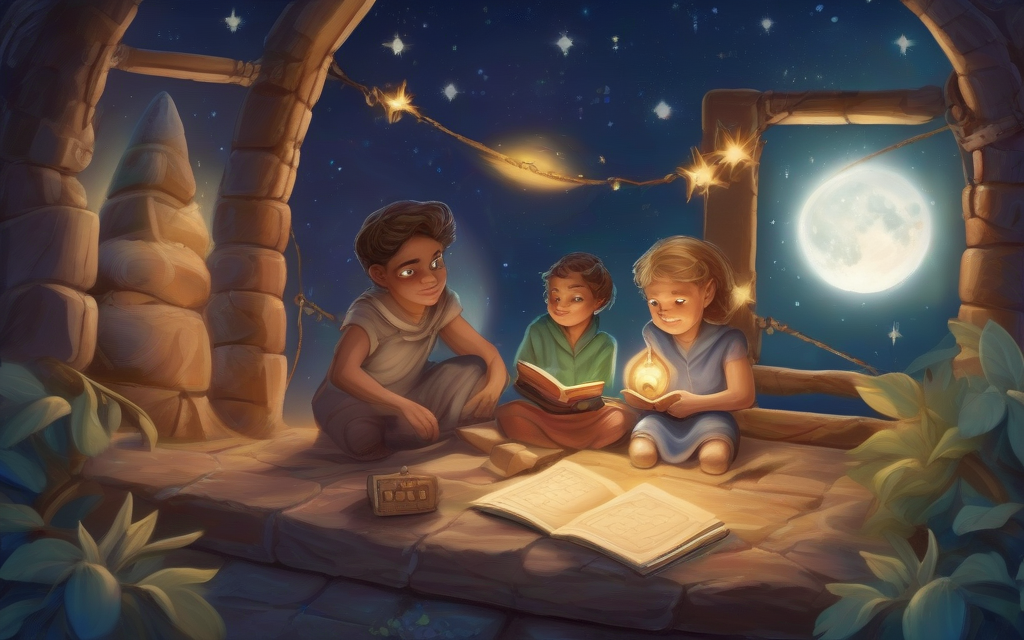
A little while later, Leo and Mia bundled up in soft sweaters. Grandma Eleanor carried a thick, cozy blanket and a thermos of warm apple cider. They walked out to a wide-open field behind the barn, where no tall trees blocked their view. The silence here was different from the house – it hummed with the sounds of the night.
Mia looked up, and her jaw dropped a little. Instead of the few blurry dots she sometimes saw from her bedroom window in the city, the sky was ablaze. Thousands, millions of tiny lights sparkled like diamonds tossed across a giant, dark cloth. It was breathtaking.
“Wow,” she whispered, her voice barely a breath. “There are so many!”
Grandma spread the blanket on the cool grass, and they all lay down, looking straight up. The air was crisp and fresh.
“Each of those tiny points of light is a star,” Leo explained, remembering a fact from his book. “They’re actually huge balls of burning gas, much bigger than our whole planet! Some are even bigger than our sun, which is also a star, of course.”
Mia giggled. “You mean all those little dots are like other suns? That’s incredible!”
“Exactly,” Grandma said softly. “And for thousands of years, people have looked up at these stars, not just to wonder, but to learn. They used them to tell time, to find their way across vast oceans, and even to predict seasons for farming.”
“But how did they know which star was which?” Mia asked, trying to keep track of one particular twinkling light.
“That’s where constellations come in,” Leo piped up, excited to share his knowledge. “People long ago imagined connecting the dots between certain stars, like a giant cosmic connect-the-dots game! They saw shapes of animals, heroes, and objects, and made up stories about them. Those patterns are called constellations.”
Grandma nodded. “Right now, if you look over there,” she pointed a gentle finger towards a bright section of the sky, “you can see one of the most famous. It looks a bit like a giant spoon or a dipper, with a long handle.”
Mia squinted. “A spoon?” she asked, a little doubtful. Leo, however, was already tracing the shape with his finger in the air.
“It’s called the Big Dipper!” Leo announced proudly. “And it’s part of a bigger constellation called Ursa Major, which means ‘Great Bear’ in an old language. Can you see it now, Mia? Three stars for the handle, four for the cup.”
Mia tried again. She focused, imagining a line connecting each star. Slowly, magically, a familiar spoon shape began to appear. “I see it! I really see it! It’s like a secret picture hidden in the sky!”
“And if you follow the two stars at the very front of the dipper’s cup,” Grandma continued, her voice like a lullaby, “they always point to a very special star. It’s called Polaris, the North Star. It doesn’t seem to move, no matter how much the other stars twirl around it.”
“It’s like a cosmic compass!” Mia exclaimed, her eyes wide with discovery. “So, if you knew where the North Star was, you’d never get lost?”
“That’s right, little explorer,” Grandma smiled. “Sailors and travelers used it for centuries. The stars were their maps, their clocks, and their storybooks, all rolled into one.”
They lay there for a long time, sipping warm cider, identifying more shapes. Leo showed Mia Orion, the mighty hunter, with his bright belt. Grandma told them the ancient Greek story of Orion, chasing after the Pleiades, a cluster of shimmering stars known as the Seven Sisters.
Mia imagined mighty heroes and graceful maidens dancing among the stars. The vast, dark sky no longer felt intimidating. Instead, it felt like an enormous, friendly canvas, filled with art and wonder. Each twinkling star seemed to whisper a tiny secret from across unimaginable distances. She realized that the darkness wasn’t empty; it was full of light and stories waiting to be discovered.
“I never knew the night sky was so busy,” Mia said, snuggling deeper into the blanket. “It’s like a giant puzzle, and every night it shows you a new piece.”
Leo nodded, his own eyes shining with the reflected starlight. “And the best part is, you never run out of things to find. There are always more stars, more constellations, more galaxies even, out there to learn about.”
As they finally walked back towards the warm glow of the farmhouse lights, Mia held Leo’s hand. The crickets still sang, and the air was still cool, but Mia felt a new warmth inside her. She hadn’t just seen stars; she had seen a universe of curiosity, patience, and ancient wisdom.
“Thank you, Grandma,” Mia said, looking up at her. “The darkness isn’t scary at all. It’s beautiful.”
Grandma gently squeezed her hand. “It always is, my dear, if you just take the time to look for the light within it.”
The clear moral of the story is: Sometimes, what seems dark or unknown can hold the most incredible beauty and knowledge. With a little curiosity and patience, we can discover wonder in unexpected places.