# Non-Fiction Story Idea 21
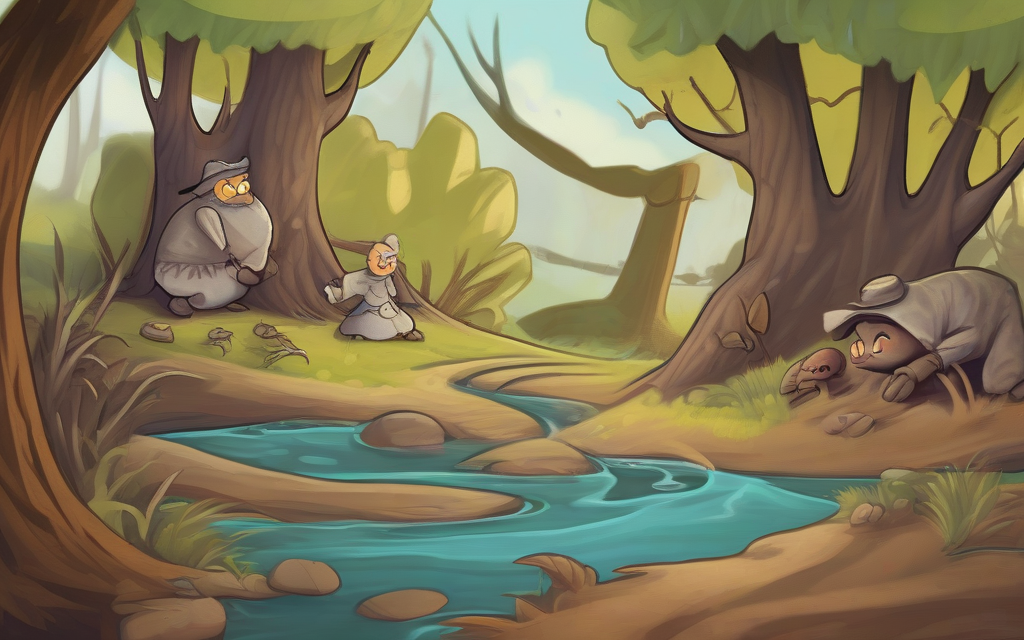
Maya, who was twelve, and her ten-year-old brother, Leo, had a special place. It wasn’t a secret treehouse or a hidden cave. It was a small, winding stream that trickled through the woods behind their house. They called it Whisper Creek because its gentle gurgle sounded like quiet secrets being shared.
All summer, Whisper Creek had been their playground and their classroom. They’d spent hours building tiny twig dams, watching shimmering minnows dart between mossy rocks, and searching for smooth, skipping stones. Maya often sat quietly, sketching the dragonflies with their jewel-toned wings. Leo, meanwhile, was an expert at spotting tadpoles and the tiny snails that clung to the underwater plants.
One sweltering afternoon, as the sun dappled through the oak leaves, Maya dipped her hand into the water. “Hmm,” she said, frowning slightly. “Doesn’t the water feel a bit…cloudy today?”
Leo, who was trying to convince a small, grumpy-looking frog to pose for a photo, paused. He looked at the water. “Yeah, it does,” he agreed. “And I haven’t seen any of the really sparkly fish for ages. Just the plain brown ones.”
They both sat down on a smooth, flat rock, looking at the creek with new eyes. Before, it had always seemed perfect, a constant source of wonder. Now, they noticed a thin layer of brownish silt covering some of the usually bright green river stones. The water didn’t have its usual crystal-clear sparkle.
“It’s like Whisper Creek is feeling a bit under the weather,” Maya said, her brow furrowed. “We have to figure out what’s wrong.”
Leo nodded seriously. “We can be…Stream Detectives!”
And so, their adventure began. They decided their first step was to observe. Really observe. The next day, armed with a small magnifying glass, a notepad, and a waterproof camera (borrowed from Dad, with strict instructions to be careful!), they returned to the creek.
They started at the edge of their yard, following the stream upstream. Maya carefully examined the water’s surface, looking for anything unusual. Leo, with his magnifying glass, peered into every tiny eddy and under every small stone.
“Look, Maya!” Leo exclaimed, pointing. “This rock used to have lots of wiggly things on it. Like little worms with feathery tails. Now it just has…gloop.”
Maya leaned closer. He was right. These “wiggly things” were often the larvae of mayflies or caddisflies, tiny insects that are very sensitive to water quality. They were like the stream’s natural thermometers, telling you if the water was healthy. Their absence was a definite clue.
As they moved further upstream, they noticed something else. Not far from where the creek meandered past Farmer McGregor’s cornfield, the banks looked a bit eroded. There were bare patches of soil, and in some places, the dirt seemed to have slid into the water. A recent heavy rainstorm had clearly washed a lot of loose soil from the field into the creek. This extra soil, called sediment, was what was making the water cloudy and burying the homes of those sensitive insects.
“So, the stream isn’t just ‘under the weather’,” Maya murmured. “It’s got a mud problem!”
They spent the rest of the morning sketching what they saw and making notes. They learned that even tiny changes could have a big impact on a whole ecosystem – that’s the word for all the living things and their environment working together. The mud wasn’t just unsightly; it was suffocating the smaller creatures and making it hard for the fish to find food.
Their detective work led them to the town library. Mrs. Gable, their old science teacher, who now volunteered there, greeted them with a warm smile. “What exciting mystery are you two solving today?” she asked.
Maya and Leo explained their observations. Mrs. Gable listened carefully, her eyes twinkling. “Ah, the Whisper Creek ecosystem needs some help, does it?” She led them to a section filled with books about local wildlife, environmental science, and water conservation.
They learned fascinating facts. For instance, did you know that different types of plants have different root systems? Some have deep roots that hold the soil firmly, preventing it from washing away during rain. These are called native plants because they belong naturally in that area. They also discovered that things like fertilizers from farms or even soap from washing a car can wash into streams and harm the delicate balance of life there.
“So, the mud from the cornfield and maybe other things are making the stream sick,” Leo summarized.
“Exactly,” Mrs. Gable said gently. “But the good news is, sometimes, with a little understanding and care, we can help nature heal.”
Inspired, Maya and Leo decided they needed a plan. They couldn’t move mountains, but they could do something. They talked to their parents, who were very proud of their scientific detective work. Together, they contacted Farmer McGregor, who was surprised but grateful that the children had noticed the erosion near his field. He hadn’t realized how much impact the storm had had.
With their parents’ help and Farmer McGregor’s permission, Maya and Leo organized a “Whisper Creek Care Day.” They invited a few friends and their families, armed with gardening gloves, small spades, and a clear mission. Instead of just picking up litter (though they did that too, carefully avoiding disturbing anything important), their main goal was to plant native plants along the eroded sections of the creek bank. Mrs. Gable even came to help, bringing some sturdy young saplings and showing everyone how to plant them so their roots would grow strong and hold the soil.
It was hard work, digging holes and gently placing the plants. But it felt good. They learned about teamwork, about how many small hands could make a big difference. They talked about the important role each plant would play, like little heroes, protecting the stream.
Weeks turned into a month. The new plants, watered by gentle summer rains, began to take root. Maya and Leo still visited Whisper Creek almost every day. Slowly, magically, the stream began to change. The water, no longer constantly churning with loose soil, started to clear. They saw more and more of those feathery-tailed mayfly larvae clinging to the undersides of rocks again. The sparkly minnows returned, darting like tiny jewels through the sunbeams. Even the grumpy frog seemed a little less grumpy.
One evening, as the sun dipped below the trees, painting the sky in shades of orange and pink, Maya and Leo sat by their now-healthy Whisper Creek. The gurgling sound was clearer, more melodic, like a happy song.
“It feels like the creek is finally telling us happy secrets again,” Leo whispered.
Maya smiled, a deep feeling of contentment settling in her heart. “It is,” she agreed. “And we helped it find its voice.”
They had started their summer with a mystery, and they had solved it with curiosity, learning, and a whole lot of caring. They discovered that every part of nature is connected, and that even the smallest actions, born from a kind heart and a desire to understand, can bring about wonderful, positive changes.
The clear moral of their story was this: **Look closely at the world around you. Even small problems can teach big lessons. And when you understand nature’s needs, your kindness and effort can help it thrive, making the whole world a little bit brighter.**