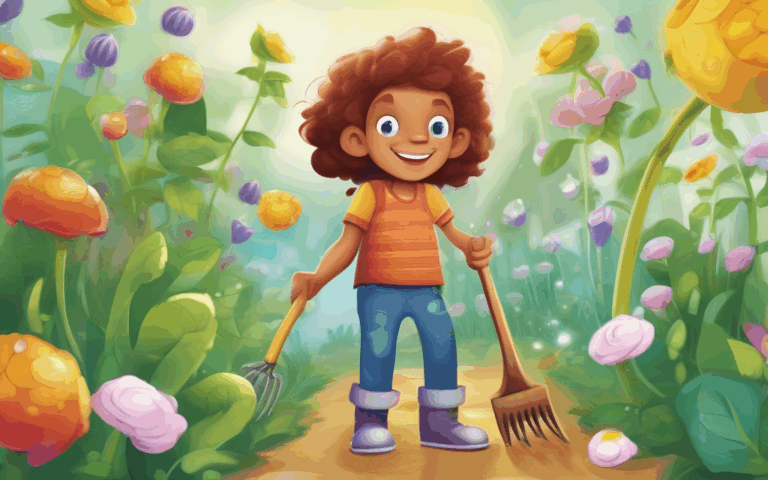

Maya was a whirlwind of energy, a bright spark in her seventh-grade class. Her ideas popped like popcorn, fast and exciting, and she loved to share them. Sometimes, though, her enthusiasm meant she was already thinking of her next brilliant thought while someone else was still speaking.
One sunny Tuesday, Mrs. Davis, their kind and calm science teacher, announced a special project. “Class,” she began, her voice soft but clear, “we’re going to design a community garden for the Meadowbrook Senior Center. It needs to be beautiful, easy for the residents to enjoy, and sustainable.”
Maya’s mind immediately zoomed ahead. A garden! She pictured vibrant flowers, little stepping stones, maybe even a tiny waterfall! She barely registered Mrs. Davis explaining the importance of choosing plants suitable for the local climate, or that the design needed to include accessible paths for wheelchairs. Maya was already mentally sketching out her masterpiece.
Mrs. Davis assigned the groups. Maya found herself with Leo, who was quiet but thoughtful, Chloe, who loved to draw intricate designs, and Ben, whose energy rivaled Maya’s own.
“Okay, team!” Maya exclaimed, bouncing in her seat as soon as Mrs. Davis finished. “I’m thinking sunflowers along the back, and a rose archway! And maybe a pond with koi fish!”
Leo cleared his throat softly. “I was just going to mention, Mrs. Davis said the senior center has limited water access, so we should focus on drought-resistant plants. Also, I read an article about how certain soil types here don’t suit roses very well without a lot of amendments.”
“Oh, right, water,” Maya waved a hand. “We’ll figure that out! But roses are so pretty! And Chloe, you can draw the archway, it’ll look amazing.”
Chloe, who had been quietly sketching in her notebook, looked up. “I was actually thinking of a raised bed garden, so residents can tend to it without bending too much. And maybe some fragrant herbs that are easy to care for.”
“That’s a good idea, Chloe,” Ben added, “and we could put some benches nearby so they can sit and enjoy the smells!”
But Maya was already looking at her own rough sketch. “Yes, benches are great! But what about making the whole garden look like a giant butterfly? We could use different colored flowers for the wings!”
The group meeting felt less like teamwork and more like Maya presenting her ideas while everyone else tried to squeeze in a word. By the end of the first planning session, they had a jumble of grand ideas, but no coherent plan, and definitely no drought-resistant plants or accessible paths.
Later that week, Mrs. Davis called Maya aside. “Maya,” she said gently, “you have such wonderful ideas and so much enthusiasm. That’s a real gift. But sometimes, the best ideas come from listening to others, too.”
Maya frowned. “But I do listen! I hear everyone’s ideas!”
Mrs. Davis smiled. “Hearing words is one thing, Maya. Truly listening means understanding, considering, and making space for others’ thoughts to grow alongside your own. Perhaps try an experiment for your next group meeting. Try to listen for twice as long as you speak.”
Maya thought about that. She was usually so quick to talk. Could she really stay quiet for that long? It sounded difficult, like holding her breath underwater.
At home that evening, Maya found her dad trying to assemble a new shelf. He was muttering to himself, looking confused. “These instructions are so tricky!” he sighed.
Maya, about to offer her own quick solution, remembered Mrs. Davis’s words. Instead, she sat down next to him and truly watched. She noticed he was skipping steps, looking only at the pictures and not reading the small print.
“Dad,” she said, very calmly, “could you read step three again, out loud, slowly?”
Her dad, surprised by her quiet focus, did as she asked. As he read, his eyes widened. “Aha! It says ‘Ensure the long screws are used for the top panel, not the side supports.’ I was using the short ones!” He chuckled. “You know, sometimes I just rush ahead.”
A lightbulb flickered in Maya’s mind. She was exactly like her dad with those shelf instructions. She rushed ahead, missing important details.
The next day, for their garden project, Maya decided to try Mrs. Davis’s experiment. When her group met, she took a deep breath.
“Okay, team,” she started, but then paused. “Before I share any ideas, I want to make sure I really understand what everyone else is thinking. Leo, you mentioned soil types and drought-resistant plants. Could you tell us more about that?”
Leo, surprised but pleased, explained that native plants were often the best choice for low water usage and healthy soil. He even had a list of local nurseries that specialized in them.
Then, Maya turned to Chloe. “Chloe, you had an idea about raised beds and fragrant herbs. Can you show us your sketch again and explain why those are good for the seniors?”
Chloe’s face lit up. She showed them her design, which included varying heights for the raised beds, some at wheelchair level, others perfect for standing. She explained how the smell of lavender and rosemary could be calming and bring back memories for the residents. Her initial sketch, which Maya had dismissed, was actually very thoughtful and practical.
Finally, Maya looked at Ben. “Ben, you were excited about colorful flowers and benches. How do you see those fitting in with native plants and raised beds?”
Ben, who usually just nodded along, now felt truly heard. He suggested grouping colorful, native wildflowers in specific sections to create vibrant bursts of color that would still be easy to maintain. He also found a design for shaded benches that would be comfortable even on hot days.
As Maya listened, truly listened, she started to see how all these pieces fit together. Leo’s practical knowledge, Chloe’s thoughtful design for accessibility and sensory experience, and Ben’s joyful splashes of color. They weren’t separate ideas; they were parts of a beautiful, complete puzzle.
Maya added her own idea, not as a command, but as a suggestion, “What if we incorporate a simple, meandering path, wide enough for wheelchairs, that winds through these different sections? It could connect all your wonderful ideas.”
The group nodded, excited. They finally had a cohesive plan. They even found a way to include a small, recycled rainwater collection barrel, solving the water problem Leo had pointed out.
When they presented their final design to Mrs. Davis, it was clear, well-researched, and brimming with care. Mrs. Davis smiled warmly. “This is excellent work, team. It’s practical, beautiful, and shows a deep understanding of the senior center’s needs.”
Later, Maya walked home, a feeling of deep satisfaction humming inside her. It wasn’t just about the A+ on the project. It was about how much more fun and effective it had been when everyone felt heard, and how much more she had learned by simply taking the time to listen. She realized that listening wasn’t just about being polite; it was a superpower. It helped her learn new things, understand people better, and solve problems in ways she never could have alone.
The power of listening is amazing. It helps us build stronger friendships, learn incredible new things, and work together to make the world a better, more understanding place. When we truly listen, we don’t just hear words; we open our hearts and minds to new possibilities.