# Non-Fiction Story Idea 3
Leo and Mia loved visiting their Grandpa Joe’s house. It wasn’t just because of his legendary pancake breakfasts, but because Grandpa Joe lived right by the ancient cliffs of Silver Creek. These cliffs weren’t ordinary cliffs. Grandpa Joe, a retired geology enthusiast, called them Earth’s biggest storybook. He said they were filled with chapters from millions of years ago, written in stone.
Leo, who was twelve, loved the idea of old stories. Mia, eleven, was more interested in what those stories looked like. Their grandpa had a shelf filled with his own finds: a perfectly swirly ammonite, a fern leaf pressed flat into dark rock, and even a tiny shark’s tooth. Each one, he’d explain, was a frozen moment in time, a clue to what the world was like long, long ago.
“Imagine,” Grandpa Joe would say, his eyes twinkling, “this very spot where we sit used to be a warm, shallow sea. Creatures swam here that look nothing like fish today. Giant dragonflies buzzed through forests of plants you’d hardly recognize.”
Mia imagined a world bathed in soft, ancient light, with strange rustling leaves and the gentle lapping of an unknown sea. Leo pictured the immense weight of time, stretching back further than he could possibly count. They were both completely hooked.
One sunny morning, after a truly epic pancake stack, Leo looked at Mia. “Grandpa says we can find our own story piece,” he announced. “A fossil!”
Mia nodded eagerly. “What kind of story do you want to find?”
Grandpa Joe overheard them. He smiled. “The best kind of story is the one you discover yourself. But it takes patience, keen eyes, and a good understanding of where to look.” He pulled out two small, sturdy hammers and some soft-bristled brushes, along with safety goggles for each of them. “And safety first, always.”
He led them down a winding path to a part of the cliff face he called “The Old Shale Layer.” The rocks here were layered like pages in a gigantic, stone book, often splitting cleanly to reveal what lay within.
“Remember,” Grandpa Joe instructed, “we’re not smashing rocks. We’re carefully peeling back the layers of time. Look for unusual shapes, textures, or colours. Sometimes, the best finds are tiny.”
Leo started enthusiastically, tapping rocks with his hammer, making small flakes fly. Mia, however, moved more slowly, her eyes scanning every inch of the gray-brown shale. She ran her fingers over the cool, rough surfaces, feeling for anything out of the ordinary.
Hours passed. The sun climbed higher. Leo found a few interesting-looking pebbles, but nothing that looked like a fossil. Mia found a pretty crystal, sparkling in the sun, but still no ancient life. It was harder than it looked.
“It’s like finding a needle in a haystack made of stone,” Leo sighed, wiping his brow.
“True,” Grandpa Joe agreed. “But every geologist, every paleontologist, knows that feeling. It’s the patience, the dedication, that leads to the ‘aha!’ moment.”
Just as Leo was about to give up and ask for a snack break, Mia let out a soft gasp. “Grandpa! Leo! Look here!”
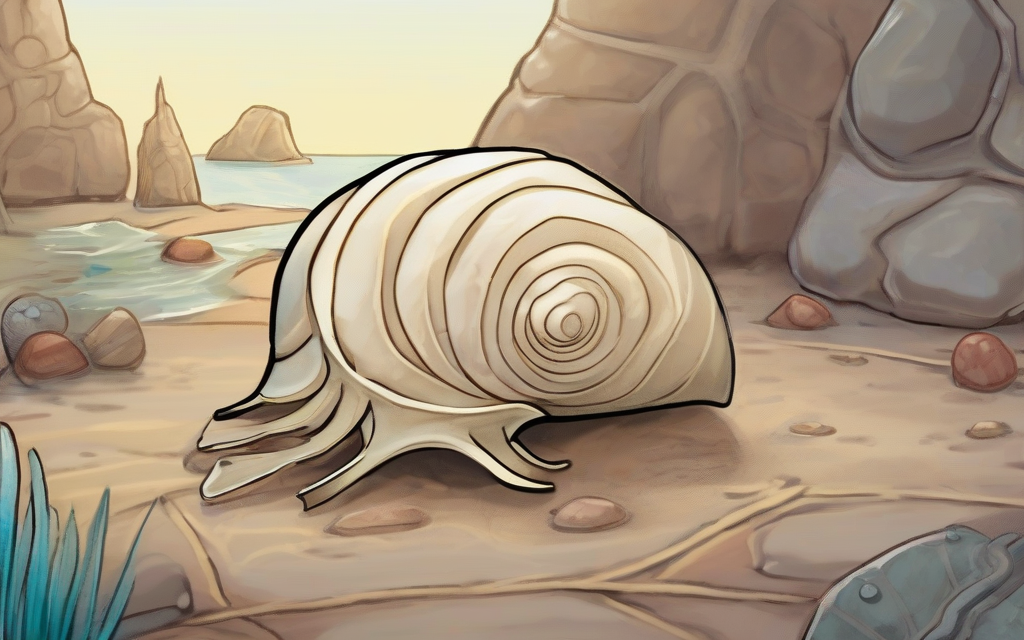
She pointed to a section of shale that had a slightly darker, almost metallic sheen. Nestled within it was a delicate, intricate pattern. It wasn’t a swirl like an ammonite, nor a simple leaf. It looked like a tiny, perfectly formed shell, no bigger than Mia’s thumbnail, but incredibly detailed, with tiny ridges fanning out from a central point.
Grandpa Joe knelt down, his face lighting up. “Well, I’ll be! A brachiopod! And a beautiful one at that.”
A brachiopod, he explained, was a shelled marine creature that lived attached to the seabed. They had been around for hundreds of millions of years, even before dinosaurs. This tiny fossil was a perfect example of how life had changed and adapted over vast stretches of time.
Carefully, guided by Grandpa Joe, Leo and Mia worked together. Leo used the hammer to gently tap away the larger pieces of surrounding rock, while Mia used her small brush to clear away the dust and reveal more of the delicate fossil. They spoke in hushed tones, their hearts thumping with the thrill of discovery. It felt like they were uncovering a secret message from a bygone era.
Finally, the small piece of rock containing the brachiopod was free. They carefully wrapped it in a soft cloth Grandpa Joe provided and headed back to the house, feeling like true explorers.
Back home, they gently cleaned their fossil. Under Grandpa Joe’s magnifying glass, the tiny ridges and curves of the brachiopod became even more amazing. It was a complete, perfect little shell, preserved for millions of years, waiting for them to find it.
“This little shell,” Grandpa Joe said softly, “is a witness. It saw oceans rise and fall, continents shift, and countless other creatures come and go. It’s a tiny piece of the Earth’s autobiography.”
Mia imagined the little brachiopod, millions of years ago, filtering food from the ancient seawater, completely unaware it would one day tell its story to two curious children. Leo felt a surge of wonder, realizing that the world around them held so many untold histories, just waiting to be discovered.
They decided to research their brachiopod, learning more about its species and the period it lived in. They even drew pictures of what their ancient sea might have looked like. Grandpa Joe helped them build a small, special display box for their find, so they could share its story with others.
That night, as the stars twinkled brightly outside, Leo and Mia didn’t just feel proud of finding a fossil. They felt connected to something immense and ancient. They understood that the Earth was a living library, and with curiosity, patience, and a keen eye, anyone could read its incredible stories.
**The clear moral or life lesson:**
The world around us is full of amazing stories, hidden in plain sight. With patience, curiosity, and careful observation, we can uncover these secrets and learn incredible things about our past, present, and future. Every small discovery, like every small effort, helps us understand the bigger picture of our world.