# Non-Fiction Story Idea 15
Leo and Mia loved visiting their Grandpa Joe’s cabin. It wasn’t just the smell of pine and warm cookies; it was the stories. Grandpa Joe had a story for every tree, every rock, and every ripple in the nearby creek. He said the world was like a giant storybook, and if you knew how to read it, you’d never be bored.
Leo, who was twelve, often pretended to be an intrepid explorer, squinting at distant hills with an imaginary spyglass. Mia, eleven, was more of a detailed observer, always picking up interesting pebbles and examining tiny wildflowers. This summer, Grandpa Joe had promised them a special adventure, one that would unlock the secrets of the past.
One sunny morning, after a breakfast of blueberry pancakes, Grandpa Joe brought out an old, dusty book with pictures of strange creatures. “Today,” he announced, “we’re going treasure hunting. But our treasure isn’t shiny gold or sparkling jewels. It’s something far more precious: stories from millions of years ago.”
Leo’s eyes widened. “Millions? Like, dinosaurs?”
Grandpa Joe chuckled. “Exactly, Leo. And even older! We’re going to search for fossils. Do you know what a fossil is?”
Mia thought for a moment. “Is it when something old turns into rock?”
“Very close, Mia!” Grandpa Joe praised her. “A fossil is a preserved trace or remnant of an organism that lived in the ancient past. Imagine a leaf falling into soft mud, or a tiny shell sinking to the bottom of a prehistoric sea. Over vast stretches of time, that mud turns into rock, and the leaf or shell leaves its permanent imprint, like a photograph taken by time itself. Or sometimes, the original material is replaced by minerals, turning it into stone.”
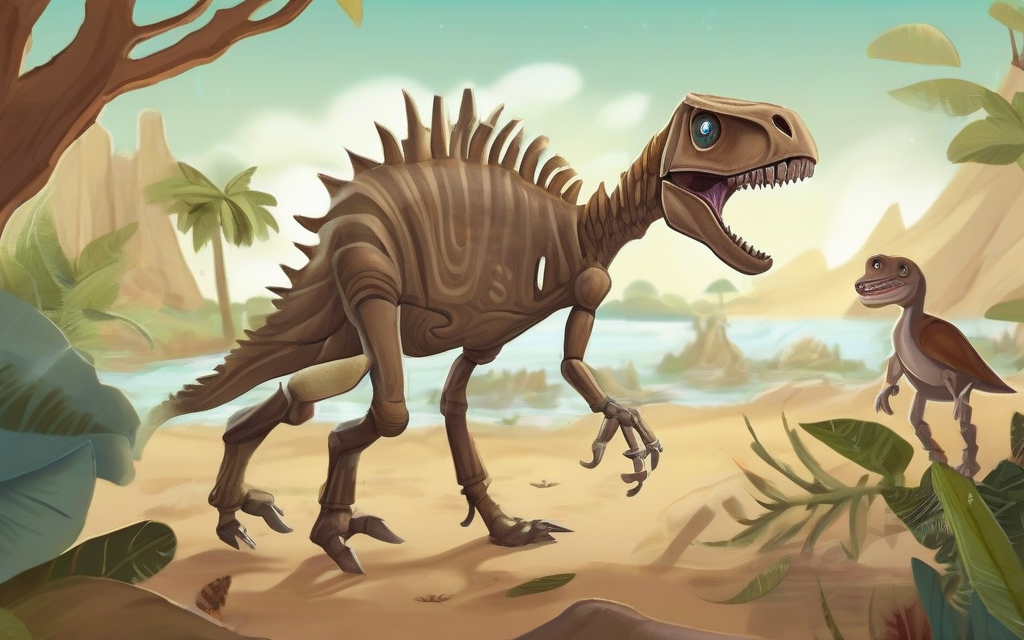
He showed them pictures in his book: elegant fern fronds etched in black rock, spiral shells that looked perfectly formed but were millions of years old, and even entire dinosaur skeletons. “Every fossil,” he explained, “is a clue. It tells us what kind of life existed, what the Earth looked like, and how things have changed over unimaginable periods.”
Leo felt a thrill of excitement. “So, there are stories hidden right here?” he asked, gesturing towards the hills behind the cabin.
“Absolutely,” Grandpa Joe affirmed. “This land wasn’t always mountains and forests. Millions of years ago, it might have been a warm, shallow sea, or a lush, swampy jungle. The rocks hold the evidence.”
He packed a small backpack with water bottles, snacks, a magnifying glass, and a sturdy old trowel. “We need our explorer’s gear, but most importantly, we need our explorer’s eyes and patience.”
They set off, following a winding path that led up into the foothills. The air was fresh with the scent of pine needles and warm earth. Grandpa Joe pointed out different types of rocks along the way. “See how some rocks are layered like a giant cake?” he explained. “Each layer tells a different chapter of Earth’s history. The oldest layers are usually at the bottom.”
They reached a rocky outcrop, a place where the hillside had eroded away, revealing ancient stone. It looked like a giant’s crumbled staircase, with ledges and cracks everywhere. “This is a good spot,” Grandpa Joe said, his voice full of quiet excitement. “The wind and rain help expose the hidden layers.”
He knelt down, running a hand over a smooth, grey rock. “Now, finding fossils isn’t like finding a dropped coin. It takes careful looking. We’re searching for anything that looks out of place in the rock – a pattern, a shape, a texture that doesn’t quite fit with the surrounding stone. It could be faint, almost invisible.”
Leo and Mia began their search. At first, it was hard. All the rocks looked pretty much the same to Leo. He picked up a few oddly shaped stones, but Grandpa Joe gently explained they were just weathered pebbles, not fossils. Mia, with her keen eye for detail, was more persistent. She noticed tiny glints of quartz, and patches of moss, but no ancient life.
“It’s a bit like being a detective,” Grandpa Joe said, seeing their initial frustration. “You have to notice every little clue, even the ones that seem unimportant. Sometimes, it’s not about finding a whole dinosaur bone, but a tiny fragment of a shell, or the delicate impression of a leaf.”
They spent the next hour examining every crack and surface. The sun climbed higher, warming their backs. Leo found a peculiar rock that looked like a fossilized worm, but Grandpa Joe identified it as a natural ripple mark from ancient flowing water – still a story, just not a living creature’s! Mia discovered a rock with unusual striations, which Grandpa Joe explained were mineral veins, formed when liquids crystallized within the rock. Each non-fossil discovery still sparked a mini-lesson about geology, making the whole landscape come alive.
Patience was the real challenge. It wasn’t an instant adventure. It was slow, methodical work. Mia almost gave up, sitting on a warm rock, munching on a granola bar. “It’s so much harder than in the books,” she mumbled.
“That’s because the books show you the amazing discoveries, not the days, weeks, or even years of searching that led to them,” Grandpa Joe replied gently. “Real science, real discovery, takes time and dedication. It’s about being curious enough to keep looking, even when it’s difficult.”
Inspired by his words, Leo decided to try a different approach. Instead of just looking at the ground, he started examining the faces of the larger rocks. He peered into crevices, imagining the rock peeling open to reveal its secret. He ran his fingers over textures, feeling for anything unusual.
Then, just as he was about to move to a new spot, something caught his eye. In a small, shadowed crevice, on a piece of rock that had broken away from the main cliff, there was a faint, fern-like pattern. It wasn’t just a shadow or a stain. It was clearly embossed, like a fragile print.
“Grandpa Joe! Look!” Leo called out, his voice a mix of excitement and disbelief.
Grandpa Joe hurried over, Mia right behind him. He carefully took the rock from Leo, pulling out his magnifying glass. “Well, I’ll be,” he murmured, a smile spreading across his face. “Leo, you’ve found a fossilized fern frond! This belonged to a plant that grew here millions of years ago, perhaps in a swampy, humid forest.”
Mia gasped. “It’s real! It’s really a fossil!”
Excitement renewed, Mia got back to searching with even more determination. She started looking at the very edges of the fallen rocks, where the surface was often fresher. And there, near where a small stream trickled over a flat stone, she saw it. A perfect, spiral shape, no bigger than her thumb, embedded in a dark grey stone. It looked like a snail shell, but it was solid rock.
“And I found one too!” Mia shrieked, holding up her discovery carefully.
Grandpa Joe examined it. “Mia, this is wonderful! This looks like an ammonite or a gastropod, an ancient sea creature. Imagine, this very spot might have been underwater for millions of years before it became land.”
He helped them carefully clean their finds with a soft brush, explaining that real paleontologists often spend days, even weeks, meticulously excavating fossils from the earth, not just prying them out. They took pictures of where the fossils were found and measured their size, like proper scientists.
Holding their ancient treasures, Leo and Mia felt an incredible sense of wonder. They weren’t just rocks anymore; they were whispers from a world that existed long before humans. Each fossil told a part of Earth’s incredible journey. Grandpa Joe explained that these little discoveries, when put together with countless others by scientists all over the world, help us understand the vast story of life on Earth, how continents moved, how climates changed, and how life evolved.
As they walked back down the hill, the world looked different to Leo and Mia. The rocks weren’t just rocks; they were time capsules. The ground beneath their feet wasn’t just dirt; it was layers of history. They had learned that the biggest adventures aren’t always about daring feats, but about quiet observation, endless curiosity, and the patience to unravel the deep, deep stories our world holds.
The greatest discoveries often come from patient observation and careful searching. Every small clue helps us understand the amazing stories of our world, past and present. The Earth truly is a living storybook, and with a little curiosity and patience, anyone can learn to read its ancient pages.