In a land spun with ancient forests and rivers that sang old tunes, lived a blacksmith named Boris. His forge stood alone at the edge of a quiet village, its hammer’s song often the only sound to break the still night. Boris was a master of metal, coaxing sparks into dragons, and iron into elegant gates. Yet, for all his skill, a quiet loneliness settled upon him like dust on an unused anvil. His hands were strong, his heart, however, yearned for distant horizons, for new melodies and friendly faces beyond the familiar path.
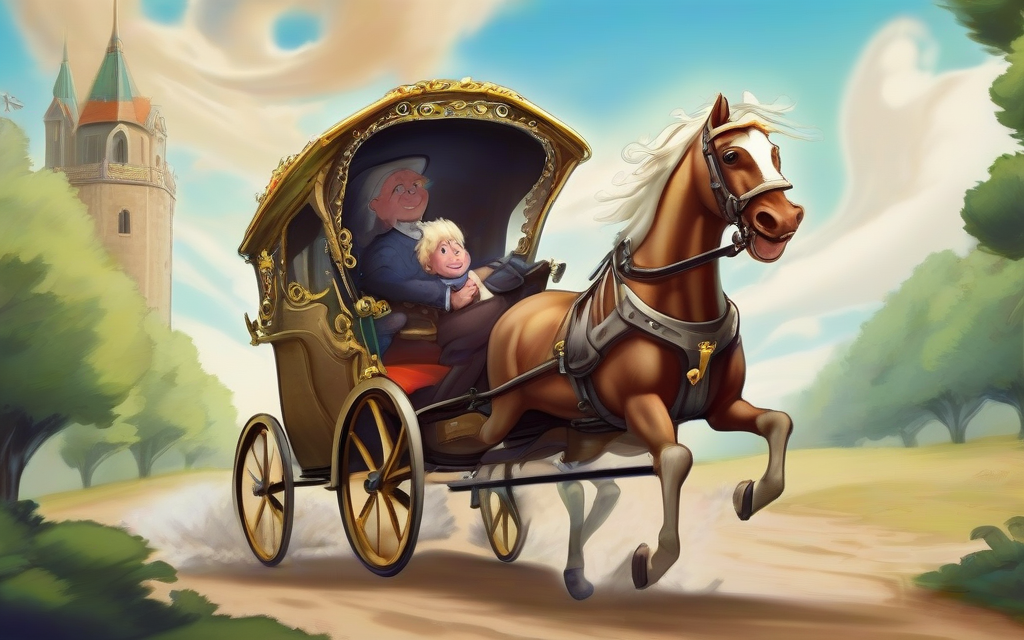
One night, as the full moon hung high and round, painting the world in silver, a strange thing happened. At the stroke of midnight, not a whisper before or a heartbeat after, an old wooden carriage appeared right outside Boris’s forge. It was carved with swirling patterns, its wheels thick and mossy, as if plucked from a forgotten tale. No horses stood before it, yet it hummed with a soft, unseen energy, waiting. Boris, rubbing sleep from his eyes, stared. He had lived by the forge for many years, but never had he seen such a wonder.
He stepped closer, his breath catching in the crisp air. The carriage door, though ancient, swung open with an invitation that felt as old as time itself. A strange pull urged him inside. With a brave heart, Boris climbed in. The interior smelled of old wood and moonlight. He settled onto a velvet seat. “Where to?” he wondered aloud, a silly thought, yet the words felt important. “The sunny meadows of Whisperwind Village!” he declared, naming a place he’d only heard about in travelers’ tales, a village many days’ journey away.
Faster than a shooting star, the world outside blurred. The forge, the village, the familiar trees, all became a rushing swirl of silver light. Boris gripped the seat, his heart thrumming like a plucked harp string. Then, as suddenly as it began, the motion ceased. He peered out. Before him lay a village bathed in moonlight, but with thatched roofs he’d never seen and the faint scent of unfamiliar wildflowers. He was in Whisperwind! The invisible horses had carried him across lands, faster than any hawk could fly.
From that night on, Boris’s world expanded. Every full moon, at midnight, the carriage would appear. He would speak a new destination, a far-off town, a mountain hamlet, a coastal port. He shared his blacksmith’s art, mending tools, crafting beautiful trinkets, and teaching young apprentices the secrets of the forge. In return, the people shared their stories, their laughter, and their songs. Boris collected melodies like precious coins, his loneliness melting away with each new friend. His heart, once a quiet room, now echoed with joy and camaraderie.
Word of the traveling blacksmith and his invisible carriage spread across the land, reaching the ears of Count Grigor. The Count was a man whose smile never reached his eyes and whose heart was as cold and sharp as the winter wind. He desired all things rare and wonderful, not for beauty, but for possession. “An invisible carriage that travels anywhere?” he boomed, stroking his thin beard. “That shall be mine! Imagine the riches I could gather, the power I would wield!”
Count Grigor sent his watchful guards to follow Boris. They were tasked to discover the secret of the carriage, but the midnight appearances were swift and silent, leaving the guards baffled. “It vanishes like mist, Your Excellency!” they reported, trembling. The Count grew impatient. He laid traps, spreading nets in meadows, digging pits in forests, hoping to snare the magical transport. But Boris, growing wiser with each journey, sensed the danger. He would simply speak a new, unexpected destination, and the carriage would whisk him away, leaving the Count’s schemes in tangles.
One fateful full moon, the Count grew bolder. He gathered his entire regiment, surrounding Boris’s forge with a ring of steel and torches. As midnight neared, Boris finished a small, delicate bird crafted from iron, his heart heavy. He knew this night was different. The carriage shimmered into view, its ancient wood glowing softly. Just as Boris reached for the door, the Count himself stepped forward, a triumphant sneer on his face.
“So, the magic is real!” Count Grigor declared, his voice echoing. “You shall hand over your carriage, blacksmith. It belongs to me now, by right of capture!” His guards advanced, their swords glinting in the moonlight. Boris looked at the greedy Count, then at the beautiful, silent carriage. He understood then that such a gift was not meant for a heart like Grigor’s.
A sudden, strong feeling surged through Boris, a feeling of courage and clarity. He stepped forward, placing his hand gently on the carriage’s smooth, carved wood. “This carriage,” he proclaimed, his voice clear and resonant, “is not merely a vehicle. It is a spirit of journey, a whisper of discovery. And a spirit cannot be owned by greed.” He looked directly at the Count, then at the invisible horses that only he could feel. “From this moment forth,” Boris announced, his voice ringing with a power he didn’t know he possessed, “you shall no longer be merely a carriage. You shall be known as… Freedom!”
As the last syllable left his lips, a gust of wind, unseen but felt, swirled around the carriage. It shimmered, then began to fade, not like mist, but like a dream forgotten at dawn. The Count cried out in rage, lunging forward, but his hands grasped only empty air. In an instant, the old wooden carriage, the invisible horses, and the very magic that had powered them, were gone. The Count’s army stood bewildered, staring at the empty space where the wonder had been.
Boris stood alone, a sad but knowing smile on his face. The carriage was gone, but the songs and stories he had gathered remained in his heart. The friendships he had forged across distant lands still bound him. He knew the carriage had vanished because its essence was pure, and true freedom cannot be claimed by a greedy hand.
From then on, Boris traveled on foot, or by simple cart, but his journeys continued. He still visited villages, sharing his skill, his songs, and his laughter. He carried kindness in his heart like a warm lantern. One cold, rainy evening, far from any village, he found an old woman struggling with a broken wheel on her cart, her face etched with worry. Without a thought for his own comfort, Boris spent hours mending the wheel, refusing any payment, only accepting her tearful thanks. As the full moon broke through the clouds, illuminating the mended cart and the grateful woman, a faint, familiar shimmer appeared at the edge of the forest. The old wooden carriage, beautiful and silent, stood waiting once more. For true kindness, like true freedom, always finds its way home. And Boris, with a joyful heart, knew his journeys had only just begun.