Non-Fiction Story Idea 28
**The Sky Dancers’ Secret**
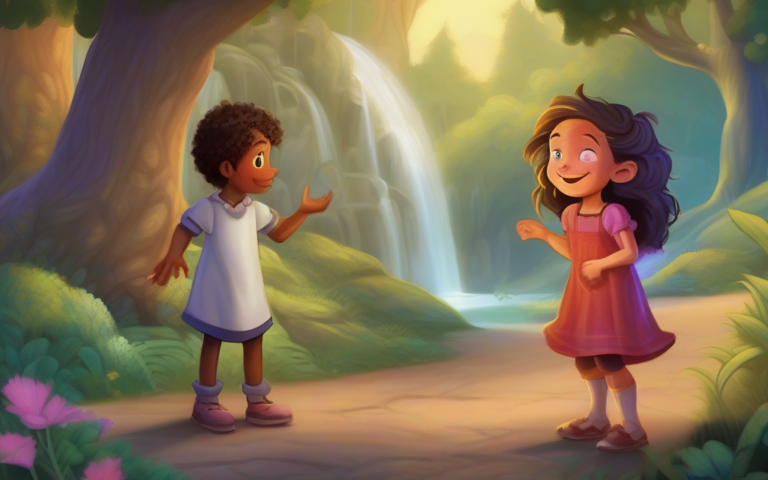
Maya, who was twelve, loved the deep, quiet winters of her northern hometown. Her brother, Leo, ten years old and always full of questions, felt the same. Their small house, nestled among snow-dusted pine trees, became a cozy haven when the days grew short and the nights stretched long. It was during these long, dark evenings that their Grandma Elara would tell them stories.
Grandma Elara had eyes that sparkled like frost on a windowpane. She often spoke of the ancient tales from their ancestors, especially about the “Sky Dancers.” These were mysterious lights that sometimes appeared in the heavens, swirling and shimmering in vibrant colours. Some old stories said they were spirits dancing, others believed they were messages from distant worlds.
“Imagine, children,” Grandma would whisper, her voice soft as falling snow, “ribbons of green and pink, sometimes even purple, painting the entire sky!”
Maya and Leo listened, their imaginations sparking. They had seen pictures of these Sky Dancers, also known as the Aurora Borealis, in books. But Grandma’s stories made them feel real, like something alive and magical.
“But what *are* they, really, Grandma?” Leo asked one evening, his brow furrowed with curiosity. “Are they actually spirits?”
Grandma Elara smiled warmly. “Well, my little explorer, the old stories tell us one thing. But the world has many wonders, and sometimes science helps us understand the magic in a different way. Why don’t you two become sky detectives and find out the Sky Dancers’ secret for yourselves?”
Maya and Leo loved a good mystery. The idea of being “sky detectives” excited them. They decided right then and there that their mission was to see the Aurora Borealis for real and understand what made it dance.
Their first step was research. They borrowed every book about the night sky from their small town library. They spent hours huddled together on the living room rug, a thick blanket over their laps, flipping through pages.
“Look at this, Leo!” Maya exclaimed, pointing to a diagram. “It says here the sun sends out tiny, invisible particles all the time. They’re like a gentle breeze from the sun.”
Leo leaned closer. “A sun breeze? That sounds cool! But how does a breeze make lights?”
“Well,” Maya read on, “the Earth has a giant invisible shield around it, called a magnetic field. It’s like a big, strong hug that protects our planet. When those sun particles try to get to Earth, this magnetic field usually pushes them away.”
“Like a cosmic bouncer!” Leo giggled.
“Exactly!” Maya agreed. “But at the very top and bottom of the Earth, near the North and South Poles, the magnetic field is a little bit weaker, like tiny doors are left open. So, some of those sun particles can sneak in!”
The two detectives learned that when these speedy solar particles zoomed into Earth’s atmosphere, they bumped into tiny gas particles already there, like nitrogen and oxygen.
“It’s like hitting a giant gong!” Leo exclaimed, imagining tiny particles clanging together.
“Close!” Maya corrected. “When they hit each other, they don’t make a sound we can hear. Instead, they make light! Different gases glow different colours. Oxygen often glows green and sometimes red, and nitrogen can make blue or purple light.”
This was the science behind the Sky Dancers! It wasn’t spirits, but an incredible light show created by the sun, Earth’s magnetic field, and tiny gas particles. Knowing this made the phenomenon even more amazing to them.
But knowing the science was one thing; actually seeing the aurora was another. Grandma Elara explained that it needed a very dark night, far away from city lights, and a clear sky with no clouds. Most importantly, there had to be enough “sun breeze,” or solar activity, for the particles to come near Earth.
“Patience is key, my little sky detectives,” Grandma said gently. “The Sky Dancers don’t always perform on demand.”
And so began their quest. Every clear night, Maya and Leo would bundle up in their warmest coats, hats, and scarves. They’d stand on their porch, gazing up at the vast, star-filled sky. They learned to identify constellations and even some planets, but the vibrant ribbons of light remained elusive.
Some nights were cloudy. Other nights, the sky was clear, but the “solar wind” wasn’t strong enough. They checked online aurora forecasts, which used scientific data to predict the chances of seeing the lights. It was like waiting for a special, secret appointment.
“No dancing tonight, I guess,” Leo would sigh, his breath puffing into white clouds in the cold air.
“It’s okay,” Maya would reassure him, though she felt a little disappointed too. “We just need to keep trying. Science tells us they will dance again!” Their teamwork and curiosity kept their spirits up.
One crisp, clear evening, the aurora forecast app showed a high chance of activity. Maya and Leo rushed to tell Grandma Elara. Her eyes twinkled even more brightly.
“Tonight might be the night, children,” she said, pulling on her own thick coat. “Let’s go to the hill behind the house, where the sky is truly dark.”
They walked hand-in-hand, their boots crunching softly on the snow. The air was cold and still, carrying the scent of pine needles. The stars above them sparkled like countless diamonds on black velvet. They stood on the hill, waiting, watching. Minutes turned into what felt like hours. Leo started to shiver, not just from the cold, but from the hopeful anticipation.
Then, a faint, pale green glow appeared on the northern horizon. It looked like a soft, milky cloud at first. But then, slowly, magically, it began to stretch and brighten.
“Look!” Leo whispered, pointing with a trembling finger.
The pale glow intensified, transforming into brilliant, neon green arcs that pulsed and swirled. Ribbons of light began to undulate and dance across the sky. They moved with an impossible grace, like giant, silent waves of colour. Sometimes, a flicker of pink or purple would appear at the edges, adding to the celestial spectacle.
Maya gasped. It was more breathtaking than any picture. The lights seemed to flow and ripple, twisting into fantastic shapes before dissolving and reforming. They stretched from one end of the horizon to the other, making the entire night sky feel alive. It was both real and utterly surreal, a dream made of light.
Grandma Elara put an arm around each of them. “The Sky Dancers,” she murmured, her voice full of wonder. “They truly are magnificent.”
Maya and Leo watched, mesmerized, until the dancing lights gradually faded back into the inky blackness, leaving only the stars behind. They felt a sense of awe and quiet joy. They had not only seen the Sky Dancers but understood their secret.
As they walked back to their warm home, Maya looked at Leo. “It wasn’t magic in the old way, was it?”
Leo shook his head, his eyes still wide with the memory of the lights. “No, it was science! But it felt even *more* magical because we knew how it happened.”
And Grandma Elara, listening to their excited chatter, smiled. “That’s the wonderful thing about curiosity, my dears,” she said. “It opens our minds to new understandings, and often, the more we learn about the world, the more amazing and beautiful it becomes.”
The moral of the story is: The world is full of incredible wonders, and by using our curiosity and a little bit of science, we can discover the amazing secrets behind even the most magical-seeming things. Understanding makes wonder even deeper.