Non-Fiction Story Idea 22
Leo and Maya loved visiting their grandparents. Their grandparents lived in a cozy cottage right at the edge of the Whispering Woods. It wasn’t just any woods; Grandma often said it had a ‘hidden hum,’ a quiet song only heard by those who truly listened.
“Tomorrow,” Grandma announced one evening, stirring a pot of delicious vegetable stew, “I want you two to go into the Whispering Woods. But don’t just walk through it. Find its hidden hum. Discover its secret language.”
Leo, who loved facts and science, raised an eyebrow. “Hidden hum? Is that like… a special bird?”
Maya, always sketching fantastic creatures in her notebook, giggled. “Or maybe a friendly forest spirit, Grandma?”
Grandma winked. “You’ll have to find out yourselves. The woods will tell you, if you’re curious enough.”
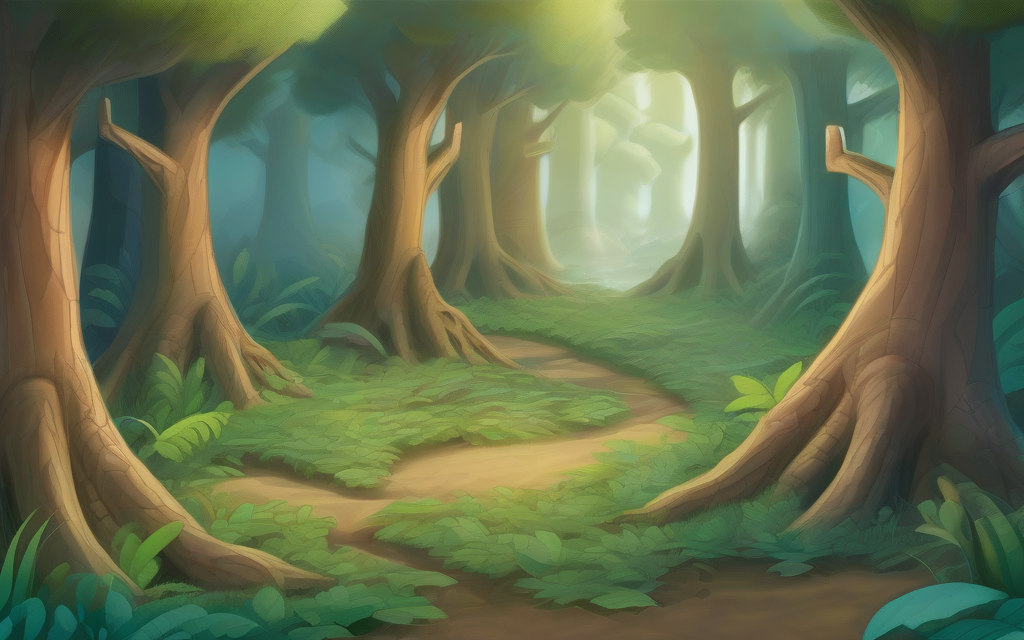
The next morning, after a breakfast of warm toast and homemade jam, Leo and Maya set off. They carried a small backpack with water bottles, a compass, and Maya’s sketchpad. The air was fresh and smelled of damp earth and pine needles. Sunlight dappled through the leaves, painting shifting patterns on the forest floor.
At first, the woods seemed like any other. Tall trees stretched towards the sky, their branches waving gently. Birds chirped overhead, and tiny insects buzzed around wildflowers. Leo pointed out a beetle scuttling across a log. “Look, Maya, a dung beetle! They help break down dead things.”
“And look!” Maya whispered, pointing to a patch of moss. “It’s like a tiny, emerald carpet. It feels so soft.”
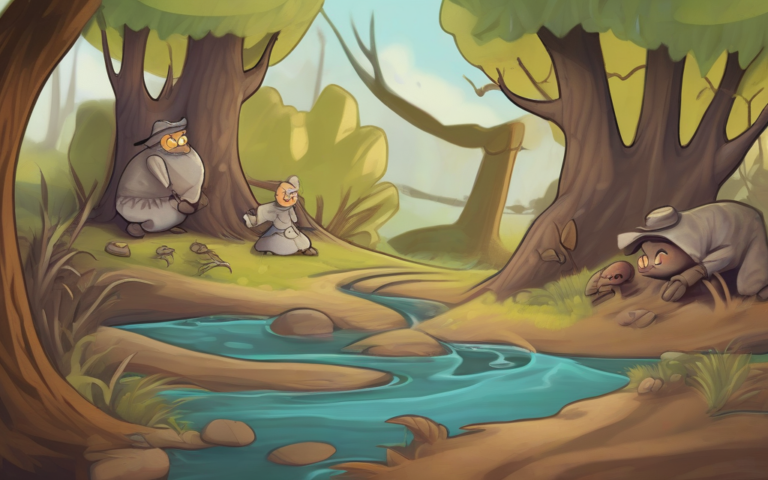
They walked deeper, observing the individual parts of the forest. They saw squirrels chasing each other up oak trees, deer delicately nibbling on leaves, and a clear stream bubbling over smooth stones. Each thing was beautiful on its own, but the ‘hidden hum’ still felt elusive.
Then, they came across a small, peculiar spot. A group of young saplings, though surrounded by lush, healthy growth, looked a little sickly. Their leaves were a paler green, and they seemed to droop.
“That’s strange,” Leo murmured. “Why would these specific trees be struggling when everything else around them is so green?”
Maya touched a pale leaf gently. “They look lonely, don’t they? Like they’re trying to whisper for help.”
They sat down, puzzled. This was a challenge. They remembered Grandma’s words about the woods’ ‘secret language.’ What could be going on?
Leo pulled out a small magnifying glass and examined the soil around the pale saplings. It looked the same as the rich, dark soil nearby. Maya sketched the drooping leaves, trying to capture their sadness.
Suddenly, Maya had an idea. “Remember what Grandpa told us about how plants eat? They get food from the soil, right? And sunlight.”
“Yes,” Leo agreed. “And water. Maybe they’re not getting enough of one of those?”
They checked the stream nearby; it flowed freely. The sun reached this spot just like others. They scratched their heads. It didn’t make sense.
As they sat there, a tiny ant crawled onto Maya’s boot. Then another, and another, forming a busy line. They were carrying small bits of leaves and other debris into a tiny hole in the ground.
“Look at them,” Maya said, fascinated. “They’re working together. Each one does a little bit, but together they build a whole home.”
Leo watched the ants. “It’s like a tiny underground city.”
That sparked an idea in Leo’s mind. “Underground!” he exclaimed. “Grandma said the woods had secrets underground! What if the problem isn’t what we see above ground, but below?”
They rushed back to their grandparents’ cottage, full of questions. Grandpa, hearing their story about the sickly saplings, smiled. “Ah, you’re getting closer to the hidden hum,” he said, pulling a large, old book from a shelf. Its cover was worn, and the pages smelled faintly of dried leaves. It was called ‘The Secret Life of Forests.’
He opened it to a page with a detailed drawing. It showed a vast network of fine, thread-like structures beneath the soil, connecting the roots of trees and plants.
“These are called mycelial networks,” Grandpa explained. “They’re made by tiny organisms called fungi. Imagine them as the forest’s own internet. Trees don’t just stand alone. They’re connected by these tiny threads, sharing water, nutrients, and even sending messages to each other.”
Leo’s eyes widened. “So, trees can ‘talk’?”
“In a way, yes,” Grandpa nodded. “A big, strong tree might share nutrients with a struggling sapling through these fungal friends. Or they might warn each other about pests.”
Maya traced a finger over the drawing. “So the whole forest is like one giant, connected family?”
“Exactly,” Grandpa said. “And if something happens to that network in one spot, it can affect the trees there, even if everything else looks fine above ground.”
Leo and Maya looked at each other. They understood now. The sick saplings might be disconnected from the forest’s ‘internet.’
They hurried back to the woods, a new understanding glowing in their minds. They didn’t dig anything up; they knew how fragile those connections were. Instead, they sat very still near the sickly saplings. They closed their eyes and imagined.
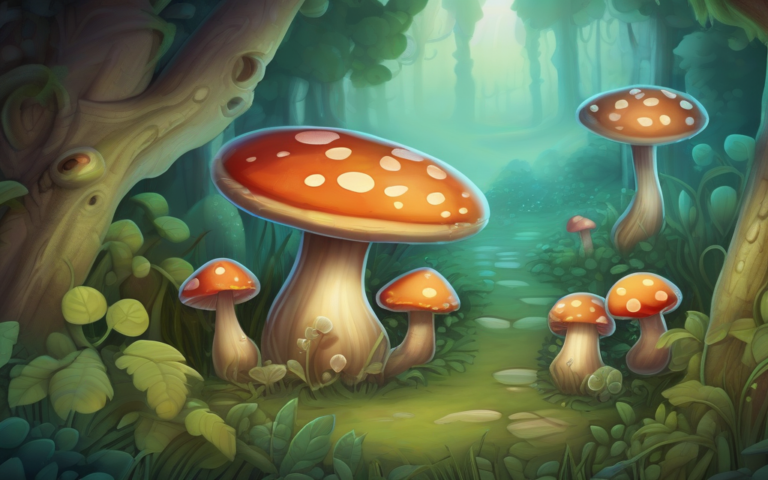
In their minds, they saw vibrant, glowing threads weaving through the dark earth, like tiny, magical pathways. They pictured these threads extending from the mighty oak trees, reaching out to the smaller plants, and imagined water and nutrients flowing along them, like little rivers of life. They saw the roots of the struggling saplings, thin and hesitant, slowly, carefully reaching out. They imagined the network strengthening, re-connecting.
They weren’t literally seeing magic, of course. But by imagining the invisible processes, the forest felt alive in a way it hadn’t before. They felt the ‘hidden hum’ – not as a sound, but as an energetic, vibrant pulse of connection.
When they opened their eyes, the saplings hadn’t magically become green again. But Leo and Maya looked at them differently. They saw the potential for connection, the patient work happening unseen. They understood that helping the forest wasn’t always about big, grand gestures, but understanding its delicate, complex systems. They knew that if they continued to care for the soil, keep the area clean, and allow nature to do its work, those connections could heal.
They returned to Grandma, their faces beaming. “We found the hidden hum!” Maya announced excitedly.
“It’s not a sound, Grandma,” Leo added. “It’s the feeling of everything being connected. Like the trees are talking underground, sharing food and water through tiny, invisible threads!”
Grandma smiled, her eyes twinkling. “You’ve understood the greatest secret of the woods, my dears. The forest is a masterpiece of teamwork, a giant family where every single part helps the others.”
That evening, as the sun set and painted the sky in shades of orange and purple, Leo and Maya felt a deep sense of wonder. The woods outside their window no longer seemed like just a collection of trees. It was a vast, intricate dance of life, a gentle hum of connection that truly made the world a magical place. And they knew they were a small but important part of it, too, just like every tiny mycelial thread.
The moral of the story is: Everything in our world, big or small, is connected. When we take the time to look closely and understand these connections, we discover amazing secrets and learn how to care for each other and the world around us.