# Non-Fiction Story Idea 17
Alex and Maya loved the ocean. Not just for splashing in the waves or building sandy castles, but for the secrets it held. This summer, they were staying with their Aunt Clara, a marine biologist, in a little house right by the sea. Aunt Clara wasn’t like other adults. Her house wasn’t filled with ordinary furniture, but with shelves stacked high with strange, beautiful shells, jars of glowing plankton, and maps marked with mysterious depths.
“Aunt Clara, what’s this?” Maya, who was eleven and loved anything sparkly, pointed to a glass orb on a table. Inside, a tiny, almost invisible creature pulsed with a soft, blue light. It looked like a living star.
Aunt Clara smiled, her eyes twinkling like the sea on a sunny day. “That, Maya, is a species of bioluminescent comb jelly. It lives deep, deep down, where sunlight can’t reach. It makes its own light, like many creatures in the abyss.”
Alex, who was twelve and always wanted to know *how* things worked, leaned closer. “But how can anything live so far down? It’s so dark, and the pressure must be enormous.”
“Excellent questions, Alex!” Aunt Clara pulled out a thick book with pictures of fantastical, glowing fish and strange, alien-like organisms. “The deep ocean is like another planet right here on Earth. Creatures there have developed incredible ways to survive. Some have enormous eyes to catch any tiny flicker of light. Others are nearly transparent. And almost all of them produce light, not just to see, but to hunt or even to hide.”
Alex and Maya spent the next few days absorbed in Aunt Clara’s books, their imaginations swimming with visions of glowing squids and giant tube worms. They learned about the Mariana Trench, the deepest part of the ocean, and how brave scientists explored these unknown worlds using special submersibles and remotely operated vehicles, or ROVs. The ocean, they realized, was far more mysterious than they had ever imagined. It was a vast, dark library filled with undiscovered stories.
One sunny afternoon, Aunt Clara announced, “Tomorrow, my research team is heading out to explore a new section of the ‘Twilight Zone’ – that’s the part of the ocean where only a faint glow of sunlight can reach. We’re deploying our new ROV, ‘Deep-Eye.’ Would you two like to come along?”
Alex and Maya’s eyes widened. “Really? On a real research boat?” they chorused.
“Absolutely,” Aunt Clara laughed. “You can be our junior scientific observers. Your job will be to watch the screens and tell us anything surprising you see.”
The next morning, the air was crisp, and the sea sparkled. Alex and Maya boarded a sturdy, medium-sized research vessel named “The Curious.” The deck was humming with activity. Scientists in lab coats checked equipment, and engineers prepared Deep-Eye, a yellow, boxy robot with cameras, lights, and robotic arms, for its journey into the depths.
As The Curious sailed further from shore, the land faded into a hazy line. Aunt Clara showed them the ship’s control room, a cavern filled with flashing lights and large monitors. “This is where we guide Deep-Eye,” she explained, pointing to joysticks and blinking buttons. “It’s like a video game, but with real-life discoveries!”
When Deep-Eye was lowered into the water, Alex and Maya watched its descent on the main screen. The water, initially bright blue, slowly turned darker, then a deep, inky black. The ship’s powerful lights helped the ROV see, but it was still a vast, unknown world.
“Look!” Maya gasped, pointing to a monitor. A cluster of what looked like tiny, floating fireworks drifted past Deep-Eye’s camera. “What are those?”
“Those are siphonophores,” Aunt Clara explained, “colonies of tiny animals that live together, creating these long, beautiful, glowing chains. Each part has a different job, working as a team to survive.”
Alex focused on another screen showing temperature and pressure readings. “Aunt Clara, the temperature is dropping really fast, and the pressure is incredible. How can Deep-Eye handle it?”
“It’s built with very strong materials, Alex,” she replied. “And its internal components are protected by special pressure-resistant housings. It’s a marvel of engineering, allowing us to ‘see’ where humans can’t safely go.”
Suddenly, one of the screens flickered. “We’re losing the main camera feed!” an engineer called out. “Deep-Eye is still responding, but we can’t see anything.”
A wave of worry passed through the control room. The team quickly tried to restore the feed, but it remained stubbornly black. Alex and Maya looked at each other. They wanted to help.
“Aunt Clara,” Maya suggested, “What if the light sensor is just blocked? Maybe something tiny is stuck on it?”
“It’s possible,” Aunt Clara murmured, “but we usually see other signs.”
Alex, remembering Aunt Clara’s books, chimed in, “Didn’t you say some creatures like to camouflage themselves? What if something is just resting on the camera, thinking it’s part of the dark ocean floor?”
Aunt Clara’s eyes lit up. “That’s a clever thought, Alex! It’s worth trying. Deep-Eye has a smaller, auxiliary camera for situations like this. It’s not as powerful, but it might give us a glimpse.”
The engineer switched to the auxiliary camera. The image was grainy, but it showed a blurry, almost invisible outline right in front of the main camera lens. It looked like a large, translucent jellyfish, gently pulsating. It wasn’t stuck; it was just *resting* there, perhaps curious about the strange yellow visitor.
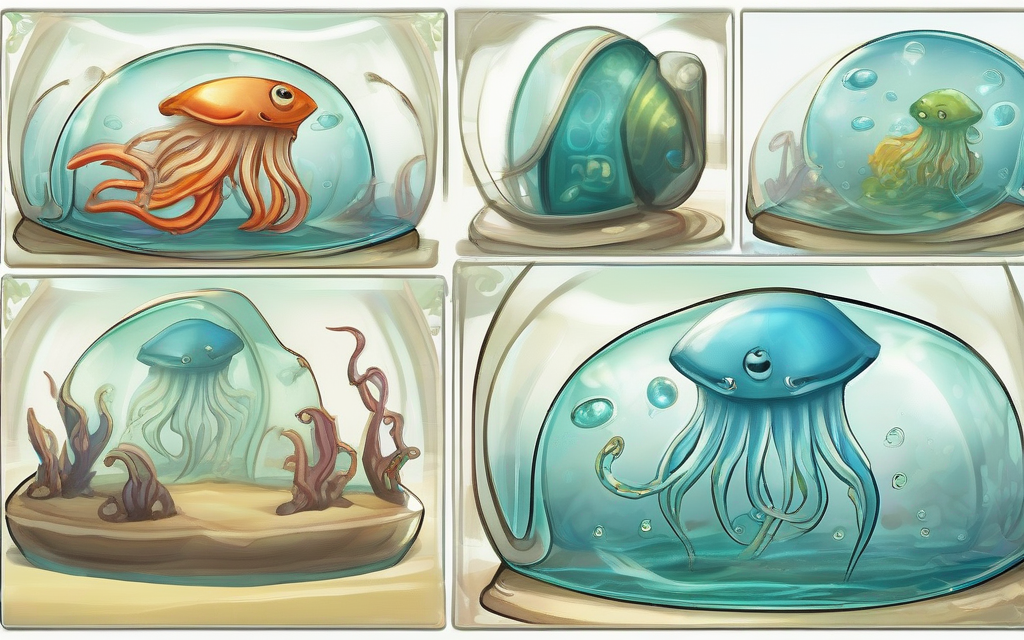
“It’s a glass squid!” Aunt Clara exclaimed, her voice filled with excitement. “They’re almost transparent, making them nearly invisible in the dim light. This one must have drifted right onto our main lens!”
With careful maneuvering, the engineer gently nudged Deep-Eye, and the magnificent glass squid slowly drifted away, revealing the crystal-clear view of the main camera once more. On the screen, the deep ocean floor spread out before them, shimmering with bioluminescent life.
The rest of the day was filled with amazing discoveries. They saw a “sea pig” — a strange, plump sea cucumber walking on tube feet. They watched tiny, glowing fish dart past, leaving trails of light. They even observed a colossal, ghostly-white jellyfish, its long tentacles trailing behind it like a silken cloud. Each creature was a testament to life’s incredible ability to adapt and thrive in the most extreme conditions.
As The Curious headed back to shore, the sun dipped below the horizon, painting the sky in fiery oranges and purples. Alex and Maya stood on the deck, feeling the cool sea breeze. They were quiet, their minds buzzing with the wonders they had seen.
“Today, you both showed great curiosity and clever thinking,” Aunt Clara said, putting an arm around each of them. “You helped us solve a problem and reminded us that every small detail matters in discovery.”
Alex looked at Maya. “Who knew the dark, deep ocean could be so full of light?”
Maya smiled. “And who knew a giant, invisible squid would be the reason we couldn’t see?”
They had learned that the world was full of amazing, real-life mysteries, far more exciting than any made-up story. They understood that curiosity wasn’t just about asking questions, but about looking closely, thinking creatively, and working together to find answers. The ocean, they now knew, wasn’t just a big blue space; it was a boundless, living library, waiting for curious minds to explore its pages.
The moral of the story is: **The greatest adventures and most astonishing discoveries often lie in the places we haven’t looked yet, and with a curious mind and a helping hand, you can uncover them.**