# Non-Fiction Story Idea 6
The summer sun streamed through the old, tall window of Grandma Elara’s cottage, waking Leo and Mia. Outside, a gentle breeze rustled the leaves of the ancient woods that bordered her garden. Leo, who was twelve, stretched and yawned. Mia, eleven, was already tracing patterns on the misty windowpane.
“Another day of… trees,” Mia sighed playfully.
Leo chuckled. “What did you expect? A theme park?”
Grandma Elara, with her warm smile and eyes that sparkled like fresh morning dew, brought in a tray of warm berry muffins. “Trees, my dears,” she said, setting the tray down, “are never ‘just trees.’ They are storytellers, scientists, and silent guardians. You just have to learn how to listen.”
Leo, a budding scientist who loved facts and figures, raised an eyebrow. “Storytellers? What kind of stories, Grandma?”
Mia, who loved to draw and imagine, leaned forward. “Are they magical stories?”
Grandma Elara took a sip of her tea. “They’re true stories. Stories of connection, of survival, of giving. This summer, I have a challenge for you. Every day, I want you to go into the woods and discover one new thing about the trees. Something you’ve never noticed before. Keep a journal – Leo, you can write the facts, and Mia, you can draw what you see and feel.”
She handed them a sturdy magnifying glass, a compass, and two new notebooks. “The woods are waiting.”
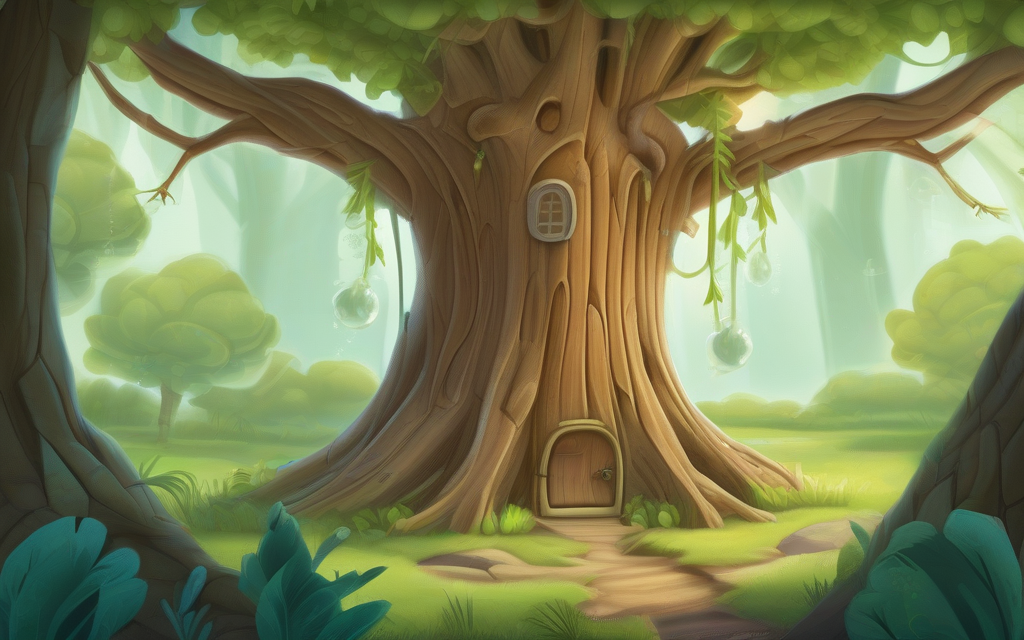
The next morning, armed with their new tools and a sense of adventure, Leo and Mia ventured into the cool, green embrace of the woods. Their first discovery was the sheer size of the old oak at the edge of Grandma’s property. Its trunk was so wide, it would take both of them holding hands to reach around it.
“It looks so still,” Mia whispered, sketching its gnarled branches. “But Grandma said it’s a storyteller.”
Leo knelt and examined the ground around the tree with his magnifying glass. “Look, Mia! Not just roots, but tiny white threads all over the soil!”
They carefully dug a little deeper, following Grandma’s instructions to be gentle. They uncovered a vast, delicate network. When they went back to Grandma, she explained. “Those tiny threads are fungi, called mycelium. They connect the roots of nearly all the trees in the forest, like a secret underground internet. They call it the ‘Wood Wide Web.'”
Leo’s eyes widened. “So trees can talk to each other?”
Grandma nodded. “In a way. The fungi help trees share water, nutrients, and even warning signals about pests or diseases. A big, old tree like our oak can support smaller, younger saplings by sending them food through this network. Imagine millions of tiny conversations happening beneath your feet, quietly sharing and helping.”
Mia closed her eyes, imagining shimmering threads of light pulsing through the earth, connecting every tree, every plant, every whisper of a root. She felt a strange warmth spread through her, a sense of immense, quiet cooperation. She drew a fantastical underground map of glowing threads connecting the roots, with arrows showing nutrients flowing from the big oak to smaller trees.
Over the next few days, their curiosity grew. They learned about **photosynthesis**, the incredible magic inside every leaf. Grandma explained how trees “eat” sunlight, mixing it with water from their roots and carbon dioxide from the air, to make their own food. In return, they release the oxygen that we breathe.
“So, every breath we take is a gift from the trees?” Mia asked, holding a vibrant green leaf gently in her palm.
“Exactly,” Grandma said. “Imagine tiny, silent kitchens in every leaf, constantly working, taking in the sun’s energy and giving us life-sustaining air. They are breathing for us, all the time.”
Leo imagined tiny solar panels and miniature factories humming softly inside each leaf. He learned that trees are truly the lungs of our planet. He wrote down facts about chlorophyll and carbon dioxide, while Mia drew a leaf that looked like it was pulsing with green light, surrounded by tiny, invisible oxygen bubbles floating upwards.
One sunny afternoon, they noticed a peculiar tree. Its trunk had a deep, curved scar, almost like a healed wound. Leo initially thought it might be damaged, but Grandma explained it was a sign of resilience.
“That scar tells a story,” she said softly. “Perhaps a storm ripped off a branch many years ago, or a deer scraped its bark. But the tree didn’t give up. It healed itself, slowly growing new bark over the wound, strengthening its trunk around the damage. Each ring inside a tree also tells a story – a wider ring for a good year with plenty of rain, a thinner one for a drought.”
Mia touched the rough bark of the scarred tree. She imagined it silently enduring blizzards and droughts, growing taller and stronger with each passing year, carrying its history within its very core. It wasn’t just old; it was wise. She sketched the tree with its scar, but added a faint aura of quiet strength around it. Leo, meanwhile, read up on how trees adapt and recover from environmental challenges, marveling at their silent fortitude.
Their journal began to fill with observations. They learned that the woods were home to countless creatures. Squirrels built nests in the branches, birds sang from leafy perches, and tiny insects scurried among the fallen leaves. Each creature depended on the trees for food, shelter, or a place to raise their young. The woods were a bustling, living apartment building, all thanks to the trees.
“It’s like a whole city,” Mia said, after observing a busy ant colony marching up a tree trunk. “But much quieter.”
One hot afternoon, as they sat sketching, they noticed something worrying. A small sapling, not much taller than Mia, looked terribly droopy. Its leaves were a pale yellow, and it seemed to be struggling.
“It needs water!” Leo declared, ready to rush to Grandma’s for the watering can.
“Wait,” Mia said, remembering their lessons. “Grandma said trees are connected. Maybe the big oak is helping it?”
They called Grandma over. She knelt beside the sapling, gently touching its leaves. “It’s true, the oak might be sending it some sugars through the network. But sometimes, even with help, a young tree needs something more. What else does a tree need besides water and food?”
Leo thought. “Sunlight? Good soil?”
“Exactly,” Grandma smiled. “Look closely around its base.”
They peered through the magnifying glass. Tall, thorny weeds had grown up all around the little sapling, blocking much of the sunlight and likely competing for nutrients in the soil.
“It’s getting crowded out,” Mia realized. “It’s not just thirsty, it’s trapped!”
Leo, remembering the resilience of the scarred tree, felt a surge of determination. “We can help it!”
Carefully, following Grandma’s guidance, they began to clear away the competing weeds. They worked slowly and gently, pulling up the intruders by their roots, making sure not to disturb the sapling’s own delicate roots or the important fungi network beneath. They made a little clearing, allowing sunlight to reach the sapling’s yellowing leaves.
“It’s like giving it room to breathe,” Mia said, wiping sweat from her brow.
They didn’t water it much, trusting the “Wood Wide Web” and the slightly damp soil. They simply gave it space, light, and peace.
The next morning, they rushed to check on their little patient. To their delight, the sapling looked a little greener, its leaves slightly perkier, reaching for the sun. Over the next few days, it continued to improve. It wasn’t a sudden miracle, but a gentle, steady recovery.
Leo and Mia felt a deep sense of accomplishment. They hadn’t just observed; they had understood and acted. The woods were no longer just a collection of trees; they were a community, a complex and generous system, full of silent wisdom and interconnected life.
By the end of the summer, their “Woods Journal” was thick with Leo’s neat facts about mycorrhizal fungi, photosynthesis, and tree rings, and Mia’s vibrant drawings of root networks that seemed to hum with energy, leaves breathing light, and trees standing strong against the elements.
They presented their journal to Grandma Elara on their last evening. She flipped through the pages, her smile growing wider with each entry.
“You have truly listened to the woods,” she said, her voice full of pride. “And in doing so, you’ve learned not just about trees, but about life itself.”
**Moral of the Story:**
Sometimes, the most amazing lessons are hidden in plain sight. All we need to do is stop, observe, and listen with curious hearts. And just like the trees in a forest, we are all connected, and helping one another makes everyone stronger and the whole world a healthier, more beautiful place.